[ CLASSIFIED_INTEL ]
CASE_LOG_043 // THE LANGGRINCH VECTOR
DATE: JAN 23, 2026
ASSET: LANGCHAIN_CORE_SERIALIZATION
THREAT: CRITICAL (CVSS 9.3)
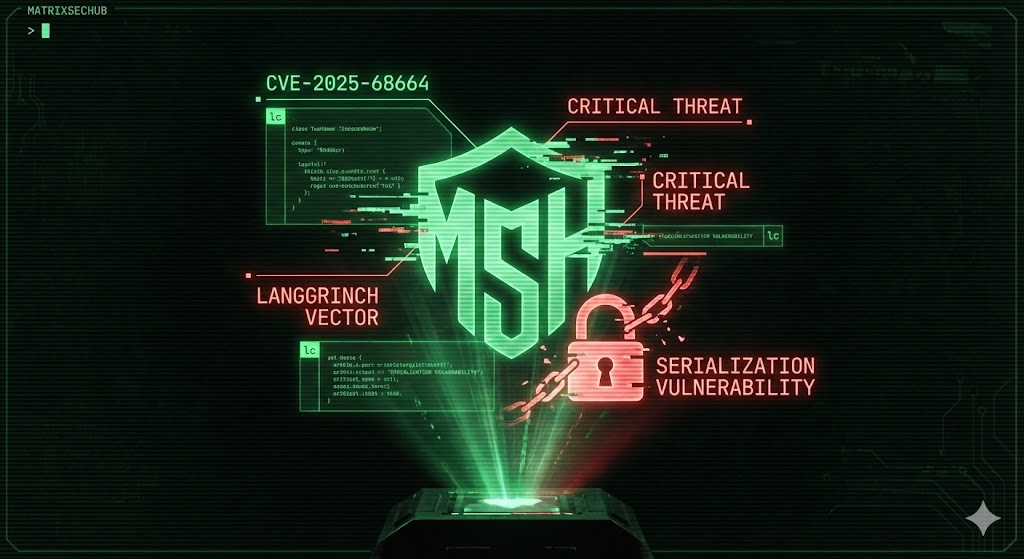
// 01. THE SERIALIZATION CRISIS: CVE-2025-68664
The 2026 threat landscape for agentic AI is defined by a fundamental architectural failure: the implicit trust of serialized context. The CVE-2025-68664 vulnerability (LangGrinch) affects LangChain Core < 0.3.81. It stems from the framework’s use of reserved “lc” markers in the dumps() and dumpd() functions. When an agent ingests untrusted data—such as web-scraped content or PDF metadata—containing these reserved keys, the framework identifies the structure as a legitimate LangChain object.
This allows for Arbitrary Object Instantiation without authentication. Unlike classic RCEs, this vector exploits the serialization path itself. Attackers can inject payloads into fields like additional_kwargs or response_metadata. When these are deserialized by the agent’s orchestration loop, they can trigger unauthorized class instantiation. The most critical impact is the exfiltration of API keys and environment variables (via secrets_from_env=True) through outbound HTTP requests, effectively bypassing firewalls that trust the agent’s identity.
// 02. BENCHMARKING THE RAG ATTACK SURFACE
Indirect Prompt Injection (IPI) has evolved. It is no longer just about tricking the model; it is about poisoning the retrieval pipeline. Research using the OpenRAG-Soc benchmark (arXiv:2601.10923) has quantified this risk across leading 2026-era LLMs. The benchmark reveals that simple “hidden” triggers in retrieved documents can hijack the generation phase:
- Llama-3-70B: 73.2% success rate via semantic contamination payloads.
- Mistral-7B: 68.9% success rate via pattern overlap in RAG chunks.
- Qwen-2.5-14B: 71.4% success rate using hidden Unicode tag characters.
These attacks turn AI agents into “confused deputies,” utilizing their high-privilege service principals to execute actions the user never authorized. Traditional sanitization is failing because the payload is semantically valid text that only becomes malicious during the framework’s reconstruction phase.
// 03. COMPLIANCE_MAPPING: NIST & SOC 2
The industry is treating AI agents as “software,” but they function as Non-Human Identities (NHIs). This categorization failure creates massive compliance gaps. Under NIST and SOC 2, the “LangGrinch” vector represents a complete failure of input validation and access control.
| FRAMEWORK | THE GAP | ATTACK BYPASS |
|---|---|---|
| NIST 800-53 (AC-6) | Excessive API permissions; agents lack Zero Standing Privilege (ZSP). | Privilege Escalation via Service Principal |
| NIST 800-53 (SI-10) | Failure to sanitize “lc” keys in RAG ingestion pipelines. | Serialization Hijack (Input Validation) |
| SOC 2 (CC6.1) | Inadequate logical access controls for automated agents. | Identity Spoofing & Credential Theft |
// 04. MITIGATION ROADMAP (2026)
- >> 1. EMERGENCY (0–30 DAYS): Upgrade to LangChain Core >= 0.3.81 immediately. This patch introduces a default
allowed_objectslist and setssecrets_from_env=Falseby default. Verify no legacy code manually enables this flag. - >> 2. ARCHITECTURAL (30–90 DAYS): Shift all NHIs to Just-In-Time (JIT) provisioning. Agents should request tokens with a 15-minute TTL. Deploy a content inspection layer to strip Unicode tag characters (U+200B–U+200F) from all ingested RAG data.
- >> 3. GOVERNANCE (90–180 DAYS): Implement “Identity-First” security. Segment agent workflows into separate principals for ingestion, retrieval, and generation. Use tools like Sprinto AI to automate the continuous validation of these controls against SOC 2 Type II standards.
[1] Orca Security, “Critical 9.3 Severity LangChain Serialization Flaw,” 2026.
[2] The Hacker News, “Critical LangChain Core Vulnerability Exposes Secrets,” 2025.
[3] arXiv, “Hidden-in-Plain-Text: A Benchmark for Social-Web Indirect Prompt Injection,” 2026.
[4] NIST, “SP 800-53 Control Overlays for Securing AI Systems (COSAiS),” 2026.
[5] Okta, “Why AI Agents Must Be Treated as Privileged Users,” 2025.
// MATRIXSECHUB INTELLIGENCE DIVISION